I almost dislocated my jaw while reading this article.
When we come to understand how brains function, we should become able to build amazing devices with cognitive abilities -- such as cognitive cars that are better at driving than we are because they communicate with other cars and share knowledge on road conditions.
Later:
As this cognitive infrastructure evolves, it may someday even reach a point where it will rival our brains in power and sophistication. Intelligence will inherit the earth.
Uhh... talk about lack of imagination. Self-driving cars? Smart power grids? Those are toys compared to other consequences of brain emulation. And "someday"? If you can model 1/1000th of a human brain at full speed today, then you'll be able to model a whole brain in 20 years (assuming no software speedups). 2 years after that, you'll have a model that runs at 2x human speed. Then it's off to the races. Biological humans are nowhere near the upper bound for intelligence. Just one example of our inefficient brains: Our neurons conduct signals at 0.000001c. If these things are as smart or smarter than us, then they'll be able to build even smarter intelligences even faster than us. Lather, rinse, repeat; you have I. J. Good's intelligence explosion.
A minor detail in this future would be, "Oh by the way, biological humans can upload themselves and become practically immortal." Seriously, cars are the best the writer can come up with?! What's the point of cars if you can transfer consciousness at the speed of light?
I don't think it's a given that our brains are "ruthlessly inefficient". In a complex system of trade-offs, they are actually pretty damn good at what they do. Human vision alone is incredibly complex. Anyone interested in how difficult it is to replicate the brain should read Steven Pinker's "How the Mind works".
Sure, the brain is impressive. It's not bad considering the limitations of biology. Likewise, I think the human eye is impressive. I'd certainly have a hard time designing a video camera made of jelly. But the brain, like the eye, is highly sub-optimal compared to non-biological solutions. The laws of physics allow for brains that run a million times faster than ours while consuming the same amount of energy. And that's without using tricks like quantum or reversible computing.
Evolution can only hill-climb. It can't jump to the highest points of the solution space, and it can't explore any areas of the solution space surrounded by valleys. This is why no animal has evolved wheels, treads, or impeller pumps. This is also why animals haven't evolved brains made out of materials that conduct signals at speeds close to c.
Evolution has limitations that go beyond inefficiency. For example: it is completely indifferent to the organisms it operates on. Evolution has absolutely no compassion. It will not select for traits that reduce suffering in dying organisms. Evolution isn't forward-looking. It doesn't notice when it starts on a journey to trap itself in a local maxima. Evolution is slow. Life started on this planet not long after the surface solidified, but it took 4 billion years for general intelligence to evolve. 4 billion years and countless organisms suffering and dying just to get 3lbs of gray matter. Had it taken much longer, the Sun would have gotten farther along in its life cycle and sterilized the Earth before evolution stumbled on general intelligence.
Sorry for that mini-diatribe, but I don't like it when people paint evolution in a positive light. It really is one of the dumbest possible ways to explore a solution space.
Trapped by a metaphor... a mind is like a computer, but a mind is not a computer. If you build a fast computer model of a mind, then you have - wait for it! - a fast computer model of a mind!
Sentience is more than just a matter of modelling, surely?
Note, I did not say that a sentient, non-human thinking being is an impossibility, but I am not sure that it would happen by building big fast models.
Ridiculous. Large-scale neuron simulations currently are like an algorithms assignment where I have some code written but don't understand the algorithm so I just tweak things all night and never get anywhere. In other words: "let's hope it does something interesting by just connecting millions of these things that we can kind of describe but don't understand at all."
We are VERY far from understanding the brain. Even for single neurons, we do not understand what is important and what we should ignore. We do not understand real-life neural networks at all. For example, we have the entire neuronal connectivity map for C elegans (only 302 neurons), the worm's genetic structure, and more -- and we still don't understand how its nervous system works, and we can't even simulate it.
This is a problem with this field -- why in the heck are we trying to simulate human and cat brains -- perhaps the most complex of them all -- when we can't even simulate a simple worm?? What ever happened to the idea of starting simple then working our way up??
I am always shocked when I look on the shelves at the bookstore and see lots of books titled "How the brain works" -- when we actually understand so little.
Having worked in AI research for a number of years in the late 80s and 90s (very much in the symbolic side of things) - I ended up thinking that the only way anyone was ever going to construct an artificial mind capable of real general intelligence is by reverse engineering biological systems. So I agree with that part of the article.
However, I wouldn't get too excited about any of this happening any time soon. Personally, I still feel the field is still thrashing around looking for an approach that achieves some kind of traction and that provides a long term basis for ongoing progress.
As is often said, AI is still in its pre-Newtonian phase - I would love for a breakthrough to happen (although you have to refer to Vinge for some potential issues with this) but I really don't expect, like with fusion, that much to happen in my lifetime.
For the foreseeable future there are only going to be intelligent entities on one side of our screens - so far a great job is being done on augmenting our own natural intelligences (e.g. Google) so I'm personally more interested in that side of things.
AI can be created today - it's just a matter of money. Put a few hundred billion dollars into genetic programming, or cyc, or data sets for a svm and you can build general AI.
There are some things that aren't a matter of money, and I would suggest "true" AI is one of them (i.e. human level general intelligence).
I honestly don't think, even if you had $100 billion, anyone would know where to start to build such a beast. It isn't just a case of building sufficiently powerful hardware - I suspect that would be the easy bit.
Spend $100 billion on CYC and you would end up with a big interesting database, not a functioning mind.
1) How did the human brain come about - evolution. So you can get there with genetic programming. How much computer time do you need - maybe $100 billion, maybe $100 trillion, but theoretically it's doable.
2) What is the brain - conventional opinion is that it's a neural network - ie. if you spend enough money as
-assemble a million neural network engineers or
-create billions of data sets to train against simple learning algorithms
you can probably replicate it's "interface"
3) You can also view a human, or at least a human speaking through email, as a database. If you had enough people working on cyc, let's say a million rather than the 20 or so it's usually had, you could get a lot closer, or exceed, human level performance.
Imagine you a couple of professors and a handful of grad students. Would they be able to build a skyscraper within 50 years, and do so from scratch, without any prior knowledge of civil engineering, no access to construction labor, and only access to raw materials? Yet that is what AI has been about for 50 years - a handful of people attempt to build something much more complex than a skyscraper.
It probably took many trillions of dollars and millions of workers to get to the point where skyscrapers could be built, and each one individually probably costs more than all the money ever spent on AI research.
Well, some people think that the brain might be doing something deeply weird with quantum level behaviors to create what we call "consciousness", if that is the case (of course a huge if) then it might not be possible to replicate it in any meaningful sense.
If you look at artificial neural networks and natural ones there are a lot of differences. Artificial neural networks are useful tools for some kind of problems, not physiological models of what happens in our brains.
They make this sound like AI is just a hardware problem, waiting to be solved by the wonder of Moore's Law. It's not. The human brain has 100 billion neurons, and 100 trillion synapses (wikipedia) - but it is the connections between them that make it do what it does. The possible connections are just mind boggling. Let's say you build hardware with those numbers (utterly non-trivial) - how does it connect together? How to we get it to structure in a way that those networks do anything? You can't expect it to wire itself into anything useful.
We have no idea how the brain does anything of significance (merging of senses into a coherent whole; memory; consciousness etc). We can't even define consciousness let alone understand how it comes about. We can't 'program' a neural network of any complexity. Even things that we take utterly for granted like object recognition is immensely complicated, let alone things that we know are 'difficult' like sentience. We can't expect this stuff to magically appear from a large neural network; nor can we program it (as we don't understand it); nor can we train it as we don't know what intermediate steps to train for.
Then, what are the inputs into it (and how are those interpreted by the hardware), and how do we get any output out of it? Let's say you solve both the hardware and the wiring problem - so you have a perfect replica human brain in a jar - how do you tell it what to do? How do you get any sense out of it?
We're fumbling in the dark here. To think those fumbles will achieve intelligence in any form in the foreseeable future is unfortunately fantasy.
This article is fluff, yes, but the subject matter is not.
1) Understanding brain function is, of course, not strictly a hardware problem, but right now hardware is the bottleneck to progress.
2) Of course the brain is complex, but it is not incomprehensibly so. The neural structure has hierarchy: cells wire into microcircuits, which combine into mini-columns, which combine into columns. These neocortical columns are more or less repeated across the surface of the cortex. The brain is not just a jumble of cells.
It's Markram's hypothesis that this is a tractable problem: understand each of the bits (ion channels, dendritic arbors, gene expression, etc.), understand how they're put together, run it through a massive supercomputer, and you've simulated a brain. Moreover, if you've done it right, that simulation should behave similarly to a biological brain. I think he's optimistic on the time scale, but I think he's within an order of magnitude and I agree his approach is sound.
3) Pretty much everything about the brain is an emergent property. As an example, the Blue Brain Project's neocortical column simulation shows alpha wave-like oscillations (private corresponence; but I believe Markram mentioned this in his TED lecture). Nowhere is there a cell ticking at 8-12Hz to create the waves. The oscillations emerge because the cells spontaneously synchronize at that frequency.
4) We can't define consciousness because it's an ill-posed question. Common definitions rest on the everyday experience of the 'ghost in the machine', when in reality that experience is an illusion of coherency created by our brains to help make sense of itself and the world. If there's one thing cognitive and neural science has shown over the past several decades, it's how small the domain of the unknowable consciousness is.
Take the work of Gazzaniga, 1998, on split brain patients, as described in the book Brain fiction (page 154, starting from the top):
Admitting that the problem is hard is important but not very helpful for actually solving the problem. Are you trying to discourage people from trying to solve it? Why, when the benefits should they succeed are astronomical? I agree that a lot of people have rosy-eyed views of an AI future, even ignoring the entire problem of Friendly AI, but why are you attacking them by just stating the difficulty of the problem instead of trying to suggest solutions? Hell, you could even donate some money to the people who do pay attention to the problems: http://www.singinst.org/
I don't know how accurate all of your "we" statements are, I'd bet at least one of them is wrong or will be wrong in the near future, considering there's about 7 billion of us and I doubt you've polled us all.
>Are you trying to discourage people from trying to solve it?
Not at all, the complete opposite. It's a fascinating area but I feel the expectations are completely out of whack with reality. Most of the articles like this have people saying we're only a decade or two away from proper AI, when I'm arguing that that is just not backed up at all - and people are underestimating what work is involved here.
When expectations are set wrong, and people eventually realise it, it can damage research in this area as people don't take it seriously any more. Ref the'AI Winter' - the dramatic cut in funding when governments realised most of the experts in the field had massively over-promised and under-delivered.
I think we need to break this down into smaller chunks of bounded problems. There is some amazing research around using human like neural networks and similar processes steps for machine vision - e.g. for object recognition, trying to mimic what happens in nature. This is greatly achievable.
Trying to model the entire human brain, with talk about how this will lead in the near future to intelligent, reasoning - even sentient AI - is fun but for the reasons I outlined needs an expectation reboot.
We're fumbling in the dark here, but that doesn't mean that we can't be close to a major breakthrough.
> We can't expect this stuff [sentience/consciousness] to magically appear from a large neural network
I actually expect those things to magically appear. If you have a functioning brain in a jar it should "come to life" automatically, because it's a reasoning machine. It reasons, therefore it becomes conscious. Just as byproduct of its complexity.
They don't seem to have a way of testing it. Sounds like Dawkins' computer models of "insect" evolution: fun, interesting and even beautiful, but not falsifiable. Visual art rather than science.
Seems they're saying they've constructed a neural network of comparable complexity to a cat's brain - for some value of comparable. And they're arguing about that value. Meanwhile, their cat's brain performs nothing like an actual cat's brain. The question doesn't even arise. But it's hard to tell, as the article is very information light.
As in code, complexity is impressive. Not necessarily useful or truthful.
Personally, I wouldn't try to build a brain like ours. Sure we have nice passions, and deep insight frequently. But there is so much badness possible with our brains. Take for instance the "cognitive cars" if we built a brain like ours, how long would it take for it to get road rage?
I would like a brain that was not like ours. I'd like something capable of deep insight and critical thinking, but nothing like a human brain.
I'm still surprised that much of the talk around future "intelligence" is geared more towards creating it from scratch (difficult) rather than enhancing or augmenting what already exists (less difficult). Regardless of this, if creating intelligence out of silicon is where the research is heading, we would have to first prove that silicon is at least an equivalently suitable substrate for hosting a model of our carbon based brain as opposed to merely assuming that whatever brain model we create can exist on any substrate.
I think more progress will be made in the meantime towards enhancing existing intelligence as it will be more immediately accessible in many cases.
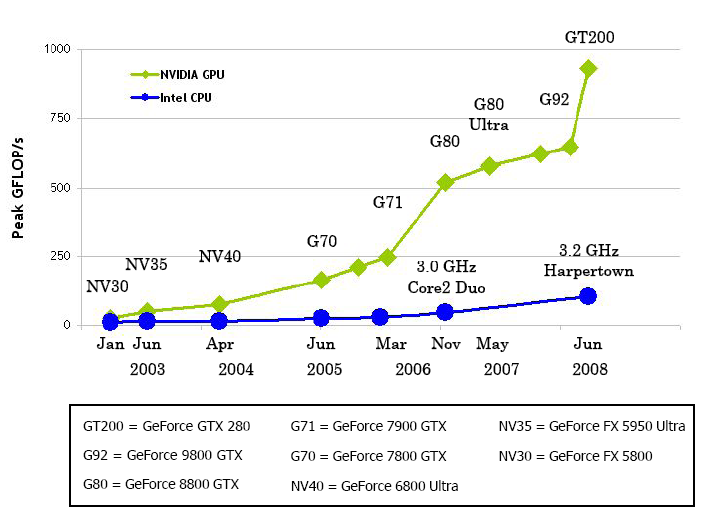
Especially on the Mac, since the vast majority of new Apple machines come with CUDA-capable NVIDIA cards now and developers can expect them.
Even so, the article was referring to the fact that you can pack that kind of power in a desktop now, regardless of whether or not the average consumer tends to take advantage of it.


When we come to understand how brains function, we should become able to build amazing devices with cognitive abilities -- such as cognitive cars that are better at driving than we are because they communicate with other cars and share knowledge on road conditions.
Later:
As this cognitive infrastructure evolves, it may someday even reach a point where it will rival our brains in power and sophistication. Intelligence will inherit the earth.
Uhh... talk about lack of imagination. Self-driving cars? Smart power grids? Those are toys compared to other consequences of brain emulation. And "someday"? If you can model 1/1000th of a human brain at full speed today, then you'll be able to model a whole brain in 20 years (assuming no software speedups). 2 years after that, you'll have a model that runs at 2x human speed. Then it's off to the races. Biological humans are nowhere near the upper bound for intelligence. Just one example of our inefficient brains: Our neurons conduct signals at 0.000001c. If these things are as smart or smarter than us, then they'll be able to build even smarter intelligences even faster than us. Lather, rinse, repeat; you have I. J. Good's intelligence explosion.
A minor detail in this future would be, "Oh by the way, biological humans can upload themselves and become practically immortal." Seriously, cars are the best the writer can come up with?! What's the point of cars if you can transfer consciousness at the speed of light?